
Chatham County Projected Versus Actual Release
A projected date is an estimate, sentence marker, maximum possible date, tentative parole month, or planned date shown before release. The exact meaning depends on the field and agency. An actual release date records that custody in a named system ended. Even an actual county jail exit may mean transfer to GDC, federal custody, another jail, or immigration custody rather than return to the community. Read the status, facility, hold, and release reason together.
Chatham County pretrial detention works differently from a state-prison sentence. A pretrial detainee has not reached a fixed sentence end date. Bond posting, a judge's order, case disposition, and outside holds can control the timing. A county sentence may depend on the court order, time already served, and jail administration. By contrast, a person in a GDC prison such as Coastal State Prison can have sentence data and parole consideration in state systems.
- Projected date
- A forward-looking date calculated or displayed before the custody event ends.
- Maximum possible release date
- A sentence-administration field that may differ from parole eligibility or a final release decision.
- TPM
- The Tentative Parole Month when the Georgia parole board expects final review, not a promised release day.
- Detainer
- A request or hold from another authority that can prevent community release after one custody matter ends.
- Actual release
- The recorded end or change of custody in a particular jail, prison, or agency system.
Find Chatham County Projected Release
Begin with the last confirmed facility. Chatham County Jail records and the court control local bond, pretrial, misdemeanor, time-served, and hold questions. GDC records and the parole board control state-prison sentence and parole questions. A person who left the county jail for GDC was transferred, not released from all custody. Likewise, the Sheriff's short booking windows may preserve a recent DIN or arrest number, but they are not projected-release calculators.
- Confirm the custody source. Use Chatham County Jail for a local booking and GDC for a state-prison sentence.
- For county custody, gather the full name, date of birth, DIN, arrest number, booking date, charge, bond entry, and holding agency when available.
- Check the Chatham court record for bond orders, sentencing terms, time served, probation action, or a transfer order.
- For state custody, open GDC Find an Offender and search by GDC ID when possible, or by name and matching identifiers.
- Review the GDC status, current or last facility, sentence data, and any release-date field displayed. Do not assume every field is final.
- Use the parole board's TPM lookup for parole consideration, then confirm the actual release through GDC, the board, or DCS.
When no online result settles the question, contact the correct records office. Chatham Jail Records is (912) 652-7734, and Receiving and Discharge/Booking is (912) 651-3700. GDC tells users to verify offender-search information through written correspondence with Inmate Records and Information, PO Box 1529, Forsyth, GA 31029. A county-jail-only person may never appear in GDC.
The GDC Find an Offender page is the official entry point for Georgia state-prison information.
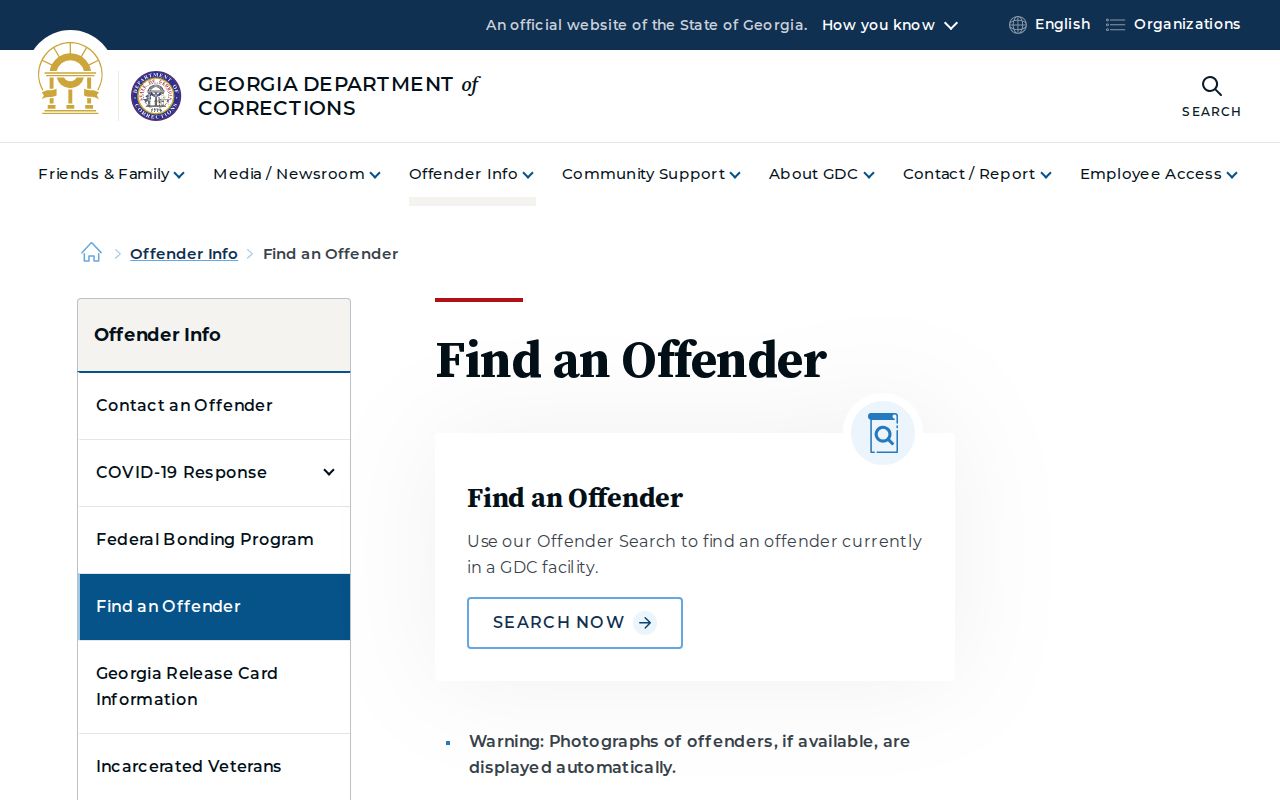
Its scope is state corrections, so county jail release timing still belongs with the Sheriff and the Chatham court record.
Chatham County TPM Release Dates
The Georgia Inmate TPM Lookup explains the search fields, while the board's TPM search application accepts a six-digit inmate number, GDC ID, or personal data. TPM means Tentative Parole Month. The board describes it as the point when final review is completed and, if appropriate, a parole release date is set. It can depend on good conduct and program completion. Therefore, a TPM should never be restated as approval to leave prison on a fixed day.
The board may deny parole, set a later review, issue a tentative month, complete final review, set a final parole release date, or change a tentative action. Conduct, program requirements, victim input, residence-plan issues, and legal limits can affect the outcome. For people already released on parole, the board's Parolee Database and DCS are more relevant than the inmate TPM tool.
The official TPM information page identifies the parole-specific lookup and explains its role.
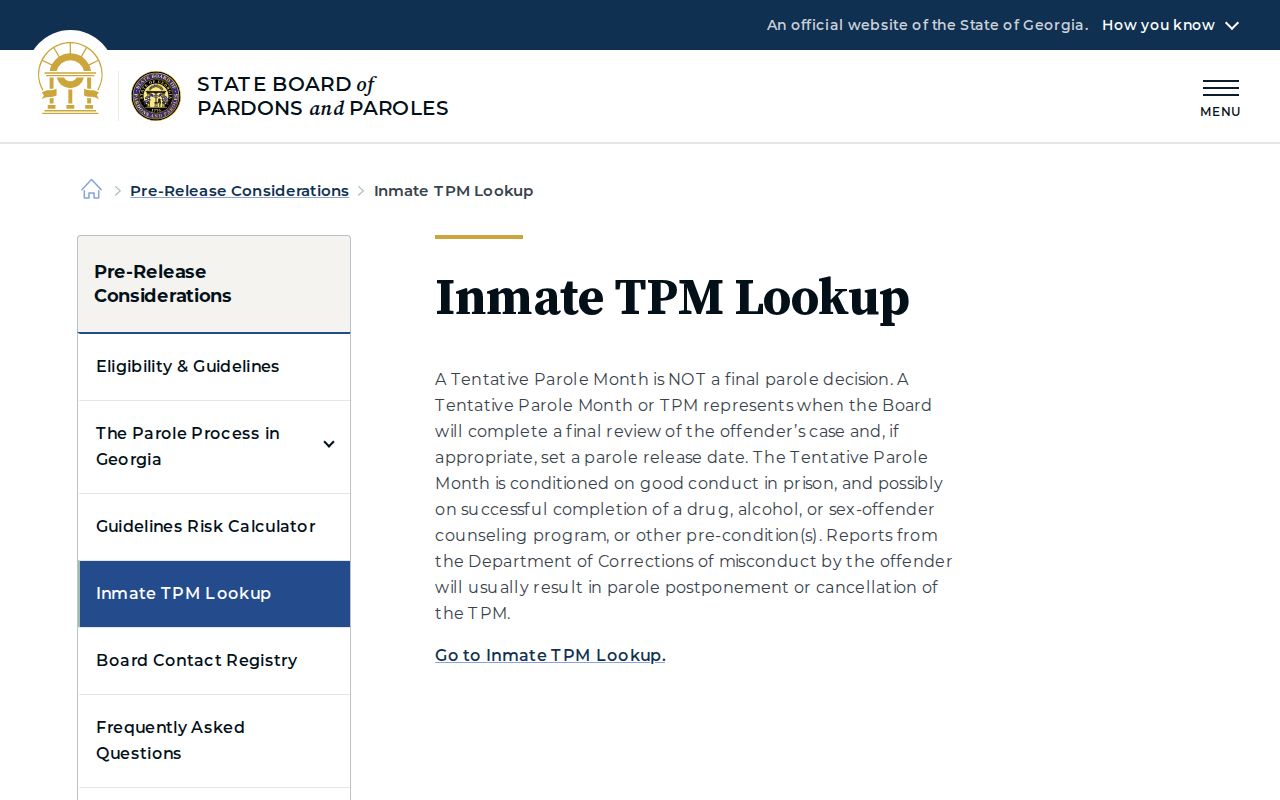
The parole screen supplies a state-prison review marker, while GDC and later supervision records establish the person's final custody path.
Note: Georgia public meetings are agency events, not a calendar of daily Chatham County parole hearings for named inmates.
Chatham County Release Eligibility Rules
Georgia does not apply one simple good-time percentage to every sentence. The controlling sentence, offense, statutes, and parole-board process matter. Under O.C.G.A. § 42-9-45, felony parole eligibility is generally after nine months or one-third of the sentence, whichever is greater, subject to exceptions. Misdemeanor eligibility is generally after six months or one-third, whichever is greater, again subject to statutory limits. Eligibility only allows consideration. It does not grant release.
The parole board's public process summary says most parole-eligible inmates become eligible after serving one-third, yet few are granted parole at the first eligibility point. The board uses decision guidelines based on crime severity and risk, while retaining discretion. Georgia Rule Chapter 475-3 also states that guideline cases not paroled or discharged earlier are reconsidered at least every five years after statutory eligibility. A reconsideration point is another review stage, not a new guaranteed date.
For serious violent felony sentences, O.C.G.A. § 17-10-6.1 imposes mandatory minimum and no-reduction rules. Covered terms are not reduced by earned time, early release, work release, leave, parole, or other sentence-reducing measures, with limited transitional-center or work-release treatment during the final year in some circumstances. For a first serious violent felony life sentence, the statute generally requires at least thirty years before parole or board-administered early release, unless another provision applies.
Those state rules do not calculate a Chatham County bond release. A local detainee's timeline can turn on bond, court action, jail processing, time already served, and holds. Apply each statute only to the sentence it governs, and rely on the sentencing court or agency record for the individual calculation.
What Changes Chatham County Release Dates
A displayed date can move for legal, administrative, or custody reasons. Some factors change sentence administration. Others change only the point when the person physically leaves a facility. A hold can keep someone in custody after a local case ends, while a transfer can end the Chatham jail event without ending confinement. The record should identify which agency controls the next step.
| Factor | Possible effect | Confirm with |
|---|---|---|
| Parole review | A TPM may be set, delayed, changed, denied, or followed by a final date | Parole board and GDC |
| Institutional conduct | Good conduct or disciplinary issues can affect a tentative parole action | GDC and parole board |
| Program condition | Required program completion can affect final review | GDC and parole board |
| Court order | Bond, time already served, revocation, or disposition can change local timing | Chatham court and jail records |
| Outside hold | Another county, state, federal, or immigration authority may take custody | Holding and receiving agencies |
| Transfer | The person leaves one facility but remains confined elsewhere | Sending and receiving systems |
| Residence plan | Unresolved placement details may delay a parole release | Parole board and DCS |
A missing online record can also create the appearance of a date change when none occurred. The person may be outside that portal's coverage, listed under another spelling, or held by a different system. Confirm identity and custody source before comparing dates from different sites.
Chatham County Jail Release Processing
Chatham's local bond process is distinct from Georgia's state-prison TPM calculation. The Sheriff's bonding procedures state that every bond has a $20 non-refundable fee. Accepted methods include cash, Visa or MasterCard payment cards, money orders, cashier checks, local bonding-company bonds, online cash bond, eligible property bonds, and approved out-of-county bonds. The detention center does not take payments by phone.
Payment details can affect when the bond process starts. Cards must be in the name of the person posting the bond, and the Sheriff's page lists card charges. Government-issued picture identification is required for several bond transactions. After the cashier booth closes, the Sheriff's Jail ATM information describes after-hours bond and kiosk options in the main lobby. These are processing channels, not a guarantee of same-day or weekend release.
Even after bond is accepted, jail staff must check the order, identity, payment, and any other holds. A state, federal, out-of-state, probation, or immigration hold can prevent community release. No official source reviewed gives a guaranteed Chatham release-processing time, so a projected hour should not be invented. Jail Records or Receiving and Discharge can confirm whether the custody exit was completed.
A cash bond return is a later court-linked task, not part of the release estimate. Chatham's procedure requires the payer's valid government-issued photo identification and a certified proof of disposition signed by the judge or clerk. Certain municipal case results send the payer back to that jurisdiction for funds. These rules show why the booking agency and court remain important after the jail exit, but they do not calculate a release date.
Confirm Chatham County Release Timing
Use an alert as a prompt to verify, not as the final record. The Chatham County VINELink inmate search explains how to follow a specific Georgia custody record and register for a status-change notice. If VINE reports a release or transfer, check the agency attached to that record. The Sheriff's jail record confirms a county custody exit, GDC confirms state-prison status, and the court explains the order behind many local releases.
For a broader record trail, the Chatham County released inmate lookup covers jail identifiers, court disposition, open-records requests, and receiving custody systems. Ask for the release or discharge record tied to the known booking or sentence. Include the full name, date of birth if known, DIN or GDC ID, arrest number, booking date, and the specific field or event that needs confirmation.
If the person is no longer visible in a short public booking window, preserve any identifier already found. Then ask whether the person bonded out, completed time, received a court order, transferred, or remained held for another agency. When GDC shows no match, verify that the person ever entered state custody before assuming the state record is missing. Conflicting dates should be compared by field name and source date. A court sentence end, a maximum possible date, a TPM, and a planned facility movement may all be valid yet describe different events. The office that created each field can explain its scope. Only the final custody record confirms that the release occurred.
Note: Confirm the actual release in the owning agency's record even when a projected date, parole notice, or court event appears current.