
Coastal Transition Release Routes
GDC identifies Coastal State Prison as the host facility for Coastal Transition Center. That official relationship controls the lookup route. A person associated with the center remains part of the state-corrections and reentry system. Release may mean movement to an approved residence, community work activity, parole, probation-related supervision, another state placement, or final discharge. Those events do not all end legal control in the same way.
A transition center is not a county jail. It helps bridge confinement and community return for eligible state offenders. Work-release or transition activity may take place while GDC authority continues. Parole can place a person in the community under conditions. Final discharge is a different record event. A Chatham Sheriff booking page matters only when the person also had a separate county booking. It cannot confirm a resident's Coastal transition status.
Confirm Coastal Transition Release
Use the GDC offender search to match the resident by GDC ID or personal details. Compare the facility, custody or status language, offense and sentence information, and any release-related date. GDC says its public page focuses on people currently in a GDC facility, so an absent result is not conclusive. Written verification is the fallback.
- Search by GDC ID when available, then verify the full name and sentence details.
- Check whether Coastal, Coastal Transition Center, another GDC facility, or a community status is shown.
- Read any maximum date, release date, and custody status as separate fields.
- Use the Parole Board TPM tool for tentative parole information, not as proof of final release.
- Check DCS for active felony probation or parole supervision in the Savannah area.
- Request GDC records when the online entry cannot resolve the placement or discharge.
Keep a copy of the identifiers used. GDC Inmate Records and Information is the record-verification source when a public page does not tell the full story.
Coastal Transition Record Meanings
Terms matter for a Coastal Transition release because physical movement is part of the program model. A resident can spend time outside a secure setting and still remain under correctional authority. The record should establish legal status, not mere location.
| Record event | What it can mean |
|---|---|
| Transition placement | Structured GDC placement connected with return planning. |
| Work release | Approved work activity that may occur before final discharge. |
| Facility transfer | Movement within GDC, not community release. |
| Parole release | Community release under parole conditions and DCS supervision. |
| Sentence discharge | The formal end of the correctional term shown by the record. |
| Probation supervision | Court-ordered community supervision that may follow confinement. |
A maximum possible release date is not always the actual exit date. A Tentative Parole Month is not final approval. Program completion is not itself a discharge record. Read each field in the system that created it.
Coastal Transition Contact Source
The research found no separate public street address, direct phone, or office hours for Coastal Transition Center that should be stated as independent facility facts. The sourced route is the host facility's official GDC page and GDC records. This avoids turning a host relationship into an unsupported stand-alone contact listing.
Coastal Transition Center
Operating agency: Georgia Department of Corrections
Official host: Coastal State Prison
200 Gulf Stream Road
Garden City, GA 31418
GDC record verification:
Inmate Records and Information
PO Box 1529
Forsyth, GA 31029
GDC inmate concerns: (404) 656-4661
The GDC Coastal State Prison page is the source that identifies the host relationship.
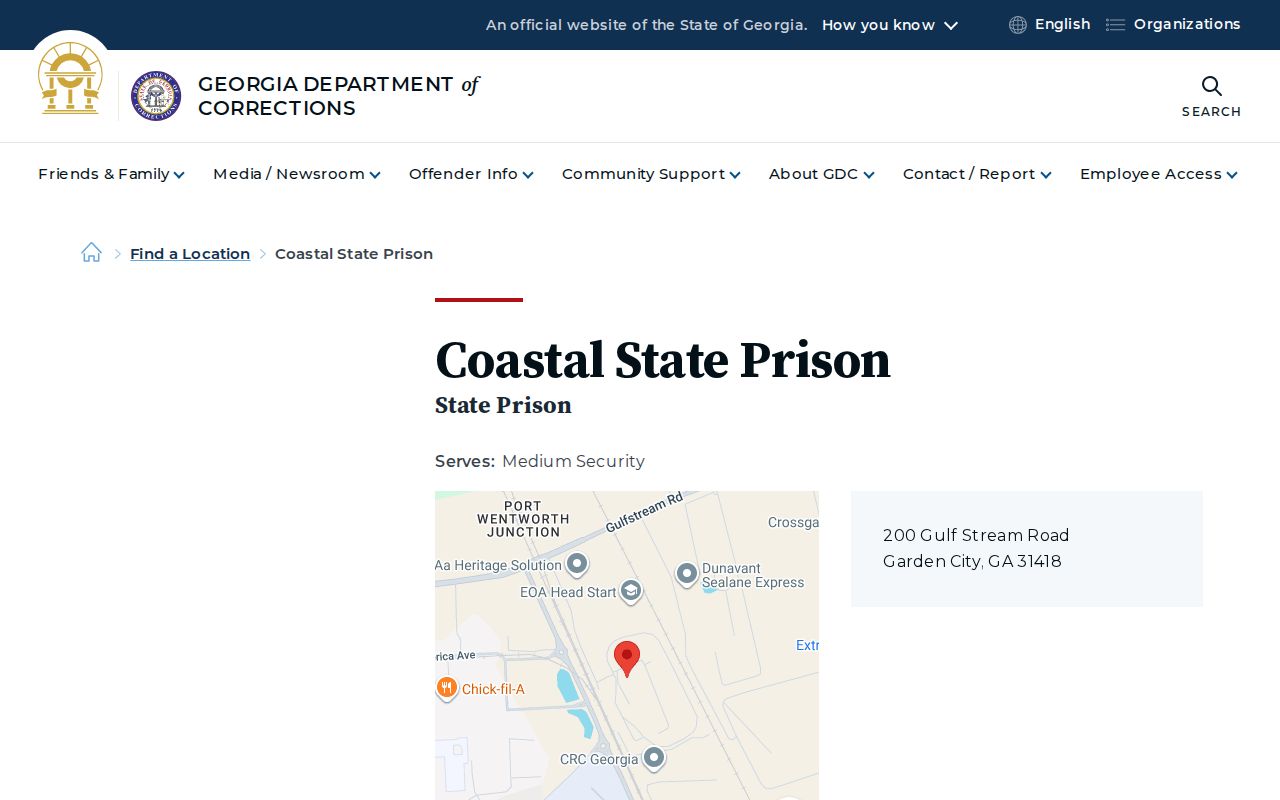
The image is presented as the host source. It does not establish a separate transition-center address or confirm any resident's release.
Coastal Transition Parole Timing
The Parole Board's TPM lookup can add context for an incarcerated state offender who may move toward community release. TPM means Tentative Parole Month. It is the month in which the board expects final review and may set a parole release date. It can change. Conduct, program completion, statutory limits, residence planning, and board action can affect the final decision.
Georgia's parole framework is not a fixed subtraction from every sentence. O.C.G.A. § 42-9-45 supplies general eligibility rules subject to exceptions. O.C.G.A. § 17-10-6.1 imposes mandatory service and no-reduction rules for defined serious violent felonies, with limited transition or work-release treatment described by statute. The Parole Board, not Coastal Transition Center, owns the parole decision.
- TPM
- A tentative month for review, not a release order.
- Parole
- Conditional community release before full sentence discharge.
- Residence plan
- The proposed living arrangement reviewed for a community return.
- Discharge
- The agency-recorded end of the correctional term.
Coastal Transition Supervision Route
After a community transition, DCS may supervise a person on felony probation or parole. The official DCS Savannah field office serves Chatham and the Eastern Circuit. That local office is the practical supervision source, while GDC remains the source for the prison or transition release record and the Parole Board remains the source for parole decisions.
DCS Savannah Field Office
15 Mersey Way
Savannah, GA 31405
Monday through Friday
8:00 a.m. to 4:30 p.m.
Serves Chatham and the Eastern Circuit.
Supervision and custody are related but distinct. A person may be out of the transition center while still required to report, follow conditions, and complete a supervision term. Conversely, someone discharged from GDC may have a separate court probation term. Match the office to the kind of status being checked.
When the question is simply whether transition-center custody ended, start with GDC. When it concerns parole approval, use the Board. When it concerns community reporting, use DCS. This three-part route prevents one source from being asked to prove a status it does not own.
Coastal Reentry Release Context
GDC's Coastal page gives Chatham County a distinctive reentry context. Coastal State Prison hosts the center and lists an Intensive Re-Entry program, Residential Substance Abuse Treatment, a Faith and Character program, and supportive living units for inmates with disabilities. These programs show that return planning may begin before a final release. They do not prove participation by any named person.
The legal record remains central. Work activity can be part of a placement. A program milestone can occur while GDC custody continues. A parole plan can lead to supervised release without sentence discharge. A transfer back to prison can also follow a status change. Each outcome should be confirmed in GDC, Parole Board, DCS, or court records as appropriate.
For Chatham County record navigation, the key is sequence: state sentence, Coastal placement, possible transition programming, community release or transfer, supervision if ordered, and eventual discharge. The countywide release records overview can help when a separate Chatham jail event also appears, but the transition-center record itself stays in the state path.
Coastal Transition Release Records
A written request is appropriate when the public search lacks a past placement, actual release date, discharge basis, or complete status history. Identify the person by full name and GDC ID. Add the known Coastal placement, approximate dates, offense or sentence details, and the precise record sought. Ask for the release or discharge record rather than a broad file if that is the only question.
GDC tells users to verify offender-search information by correspondence with Inmate Records and Information at PO Box 1529, Forsyth, Georgia 31029. The public search may change as custody changes, and a former resident may not appear in the same way as a current prisoner. A narrow written request can preserve the state agency's answer.
Do not use Chatham Jail Records as a substitute unless a county booking occurred. A local arrest followed by GDC placement can create two separate records. The Sheriff owns the jail event. GDC owns the state transition and release event. Court records own the sentence or disposition. Keeping those custodians separate produces a clearer and more accurate release history.
Coastal Transition Status Checks
A transition record can change as placement and supervision move forward. Save the GDC ID, exact status words, listed facility, sentence details, and any date shown. Then compare the Parole Board and DCS sources only for the part each agency owns. A later supervision record can confirm community status without replacing the earlier GDC placement history.
If the sources leave the release type unclear, request written GDC verification. Ask whether the Coastal placement ended by transfer, parole release, other community transition, or sentence discharge. That narrow wording gives the records office a defined event to locate and avoids treating program participation or off-site work as proof that state correctional authority ended.