
Federal Custody Release Routes
Federal custody can begin locally without ending locally. A defendant arrested in Chatham County may appear in a county booking record, move under a federal hold, travel in USMS custody, and later receive a BOP designation after sentencing. Each step has a different record owner. The Sheriff documents its jail custody event. The federal court docket documents hearings, detention orders, sentence, and case disposition. USMS manages pretrial detention and transport. BOP manages designated sentenced inmates and its own release record.
A person who leaves Chatham County Jail for USMS is not released to the community. Likewise, a move between BOP institutions is a transfer. A BOP status of Released means the person is no longer in BOP custody, but it does not explain every later supervision condition or other agency hold. Match the federal number, name, age, offense context, and court case before relying on a result.
Confirm Federal Custody Release
Start with the official BOP Inmate Locator for a person who reached BOP custody. Search by a federal register number when known or by name. BOP records cover federal inmates incarcerated from 1982 to the present. Compare identifiers carefully, then read the status and release date exactly as displayed.
- Search by BOP register number or full name and narrow with age, race, and sex when shown.
- Confirm that the person reached BOP rather than remaining in pretrial USMS custody.
- Read Released or Not in BOP custody language together with the listed release date.
- Check the federal court docket for sentence, detention, release order, or supervised-release terms.
- If BOP has no record, determine whether the matter is too early for designation or never involved BOP.
- Use BOP records channels for a durable inmate or release record.
The locator is stronger than inference from a local roster. It is still one part of the federal record, especially when the case remains open or supervision follows prison release.
Federal Release Locator Fields
BOP search results are built for identity and custody status. The register number is the most useful key because common names can produce several records. A release date is meaningful only after the correct person is matched.
| Federal field | Release use |
|---|---|
| Register number | Links the result to one federal inmate record. |
| Name | Must be checked with other identifiers. |
| Age, race, and sex | Help distinguish people with similar names. |
| Release date | Shows the BOP-recorded date, subject to later correction. |
| Location or status | Can show a facility, Released, or Not in BOP custody. |
BOP says RELEASED means no longer in BOP custody. That wording should not be expanded into a claim that all federal or state supervision ended. A separate detainer or a term of supervised release may require another record. Note: BOP warns that First Step Act sentence recalculations can affect date accuracy, so check back when a date is material.
Federal Release Record Contacts
No one federal detention facility, address, or phone serves every Chatham County federal arrest. Pretrial placement can change, and a sentenced person can be designated anywhere in BOP. The USAGov prisoner-records guide identifies the federal and state source distinction. The contact card names sourced nationwide routes instead of inventing a local federal jail.
Federal custody records
Sentenced BOP inmate:
BOP Inmate Locator and BOP inmate-record channels
Pretrial federal defendant:
Federal court docket, court or attorney channels, and USMS case routing
Local county event:
Chatham Jail Records, only for the time the Sheriff held the person
No general public USMS inmate locator equivalent to BOP was found.
The BOP federal inmate records page explains its record coverage and status terms.
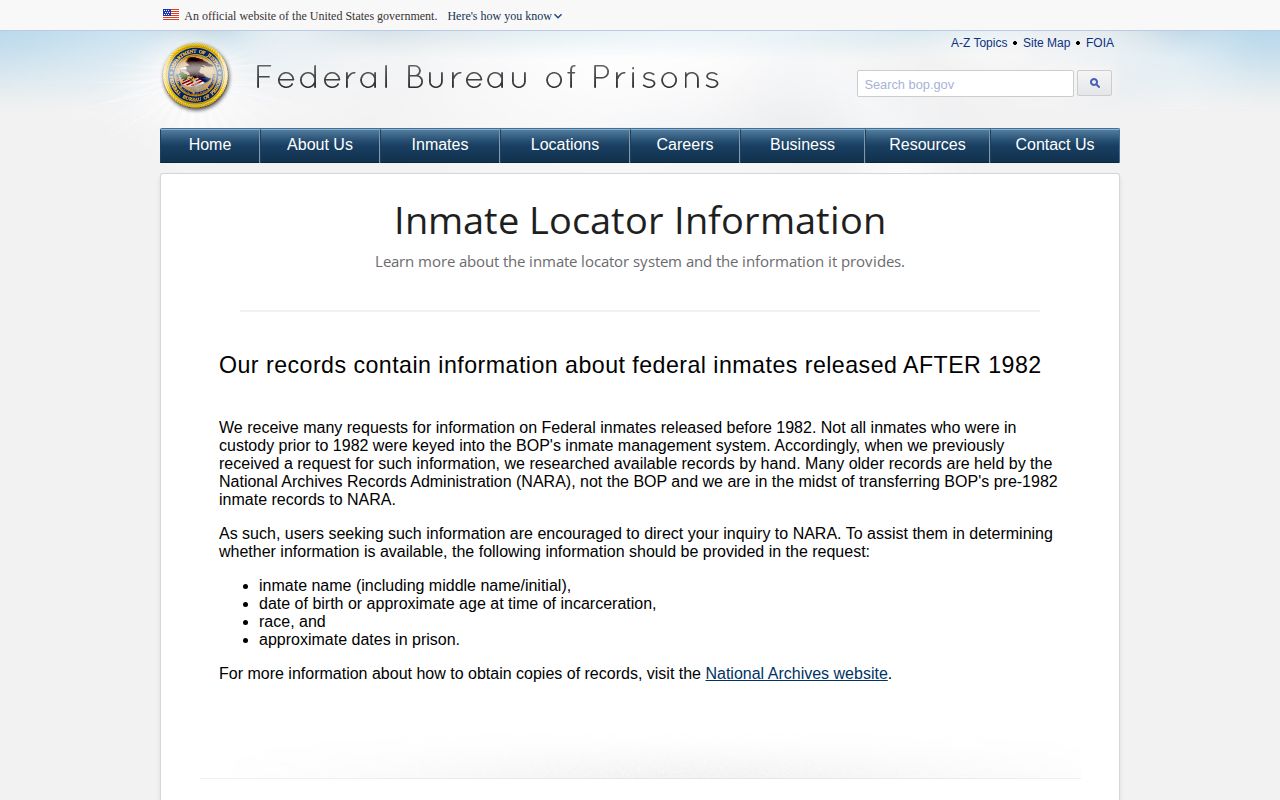
The captured source supports the BOP record scope. It does not identify where a USMS pretrial detainee is held.
USMS Pretrial Release Records
USMS manages federal detainee custody and transportation before BOP designation and during some transfers. There is no general public USMS inmate locator comparable to BOP's sentenced-inmate search. A person can therefore be absent from BOP while still held under federal authority. The federal docket is often the practical source during that stage.
Docket entries can show an initial appearance, detention or bond order, later release order, plea, sentence, and other case events. They can also identify the court and counsel. The docket is not a live detainee roster and may not disclose the exact detention site. When location is not public, the court or authorized attorney channel may be needed.
- Designation
- BOP's assignment of a sentenced inmate to its system or a facility.
- Detention order
- A court directive keeping a defendant in custody while the federal case proceeds.
- Supervised release
- Court-ordered community supervision that follows some federal prison sentences.
- Transfer
- Movement between custody owners or sites, not release.
Chatham Federal Transfer Records
The Chatham Sheriff booking page can show a local arrest or hold, but its one-day and three-day windows are not federal release archives. If the person disappears after a federal action, contact Sheriff Jail Records to determine whether county custody ended by transfer. Then follow the federal case. A county exit cannot establish what USMS or BOP did next.
Ask the Sheriff for the release or discharge record tied to the DIN, arrest number, date, and agency field. If it shows transfer to federal authority, preserve that wording. Search the federal docket with the exact name and case identifiers. Use BOP after designation. This sequence documents both sides of the custody handoff.
The Chatham County custody-system overview is useful when the record could instead point to GDC or ICE, but the person-level federal answer remains with the federal sources. Do not use Georgia VINE as a substitute for the BOP locator, and do not use the county booking window as proof of federal release.
Federal Sentence Release Dates
A BOP date may change as sentence computation changes. BOP specifically notes ongoing review and recalculation under the First Step Act. Court orders, jail credit, federal time credits, disciplinary matters, and other sentence-administration decisions can affect the displayed date. The safest wording is the date BOP currently reports, followed by verification when timing matters.
A projected date differs from actual release. An inmate can also leave a particular prison through transfer while remaining in BOP custody. After release from imprisonment, a federal court may impose supervised release. That term is administered in the community and should be checked through the federal case and supervision channels, not inferred from BOP's prison status alone.
For historical records, BOP says its locator covers federal inmates from 1982 onward. Earlier records or details beyond the locator may require archival or records-request channels. Keep the request narrow and provide the register number, full name, date of birth if known, facility, court case, and date range.
Federal Release Record Limits
“Not in BOP custody” is a system-specific statement. It can mean the person was released, never reached BOP, is outside current BOP control, or needs another federal record path, depending on the page context. Read the full result and use the docket to clarify the case stage. Do not translate absence into a specific release reason.
Federal court documents can also be sealed or partly restricted. Personal data may be redacted. USMS detention-site details may not be available through a public roster. These limits make a source chain more useful than repeated name searches: Sheriff transfer record, federal docket, BOP locator, and BOP written record where needed.
A precise request asks for the BOP release or custody record for one register number and sentence. It does not ask Chatham County to certify a federal event. Similarly, a county request should stop at the Sheriff's custody handoff. This division keeps the record accurate and respects which agency created each fact.