
Coastal Prison Release Routes
Coastal State Prison is operated by the Georgia Department of Corrections. A person leaving it remains within the state-corrections record system even when physical prison custody ends. The route may be parole, sentence discharge, transfer to another GDC site, movement through the hosted transition center, or release to community supervision. Parole is conditional release before the sentence is fully discharged. Discharge means the correctional sentence or custody term has ended as recorded by the responsible agency.
The first task is to identify which event occurred. A facility change is not a release. Placement at Coastal Transition Center can be part of a structured return process and may still carry GDC or supervision conditions. Parole can place a person in the community under State Board and DCS authority. Final discharge can end prison custody without the same supervision route. The GDC offender record, parole information, and DCS record answer different parts of that sequence. Chatham County Jail's short booking pages do not establish any of these state-prison outcomes unless the person also had a separate county booking.
Confirm Coastal Prison Release
Begin with the GDC Find an Offender page. GDC describes its public search mainly as a way to find people currently in a GDC facility, so no result does not prove release. Search with the GDC ID when possible. Otherwise compare the full name, identifying details, offense and sentence information, facility, custody status, and any release-related fields that appear. Photographs display automatically when available, according to GDC.
- Search GDC and match the GDC ID, name, current or last facility, and sentence details.
- Read custody and release fields exactly. Do not turn a location change into a discharge claim.
- For parole timing, use the Parole Board's TPM lookup and note whether the value is tentative.
- If the person is in the community under felony probation or parole, identify the DCS field office tied to the case.
- Request written GDC verification when the public result is incomplete or when a durable discharge record is needed.
The statewide search and written records are stronger than inference from a local page. GDC advises written verification through Inmate Records and Information before treating online information as complete. Its Questions About Your Loved Ones page provides an additional official routing source for family concerns without replacing release verification.
Coastal Release Search Fields
A state-prison lookup should preserve the details that distinguish one offender and one sentence from another. GDC records may present a photograph, but a photo is not the release fact. The status, facility, sentence, and date fields carry the custody meaning.
| Field | How to read it |
|---|---|
| GDC ID | The strongest key for matching the state record. |
| Custody or status | Shows whether the record reflects active GDC custody or another state. |
| Current or last facility | Separates Coastal from another institution or transfer. |
| Offense and sentence | Connects the record to the court judgment. |
| Maximum possible release date | A sentence-administration field, not a promise of the actual exit date. |
| Actual release or discharge | Use the exact wording shown and verify if needed. |
| Parole or TPM information | May point to board review; TPM remains tentative. |
A county-only detainee may never appear in GDC. Conversely, a GDC offender released from Coastal will not be confirmed by disappearance from a Chatham Sheriff booking window. Note: Match the custody owner before interpreting any date.
Coastal Prison Contact Records
The official GDC location page provides the physical and mailing addresses. Release and sentence verification should go through GDC records, while facility contact can route questions about the location. The research does not provide a facility-specific public release desk phone, so none is inferred here.
Coastal State Prison
200 Gulf Stream Road
Garden City, GA 31418
Mail:
PO Box 7150
Savannah, GA 31408
GDC verification:
Inmate Records and Information
PO Box 1529
Forsyth, GA 31029
GDC inmate concerns: (404) 656-4661
The GDC Coastal State Prison source page identifies the prison, its addresses, custody level, capacity, and programs.
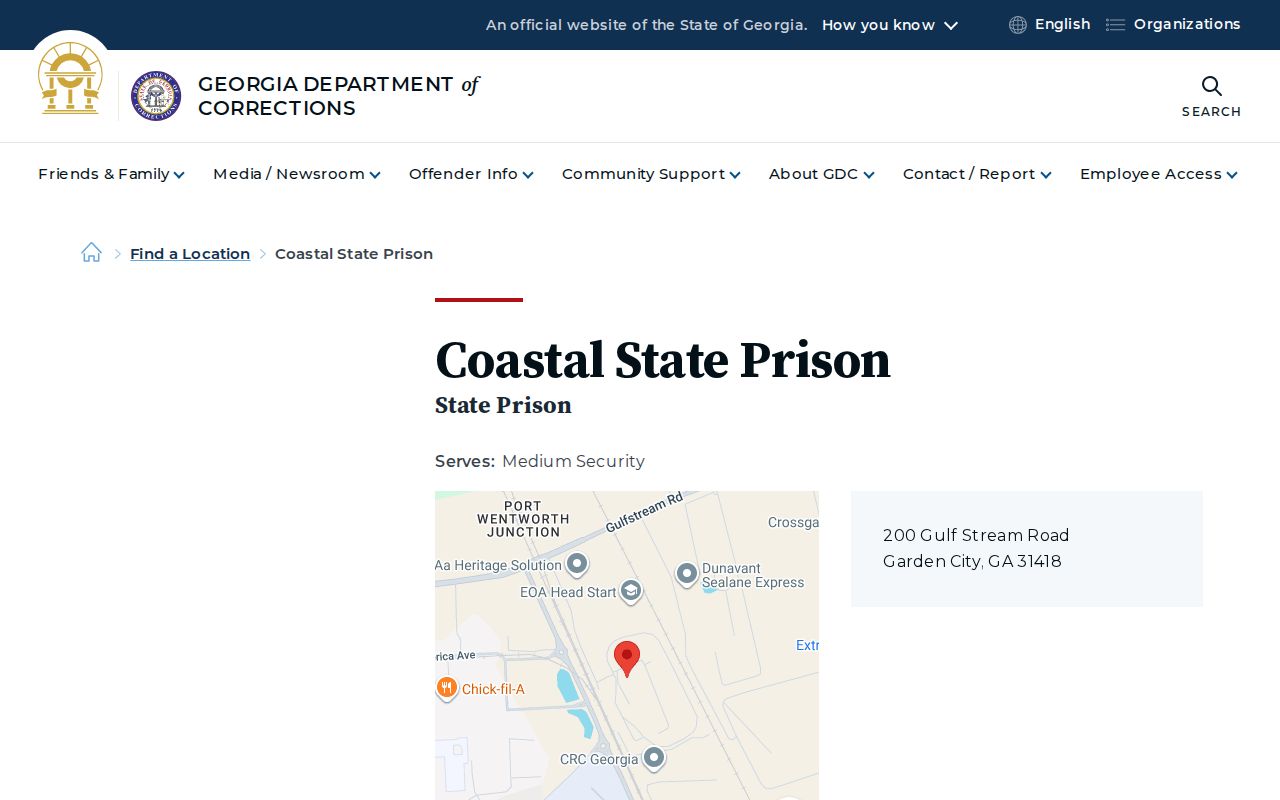
The screenshot confirms the official facility source and local prison context; person-level release facts still come from the offender and records systems.
Coastal Prison Facility Record
GDC describes Coastal as a medium-security prison for adult male felons. It was constructed and opened in 1981, renovated in 1999, and has a sourced capacity of 1,836. The prison houses an abbreviated Diagnostic Unit and a Tactical Squad. Those facts identify the type of custody and explain why county-jail procedures do not fit. Sentenced state offenders follow GDC sentence administration, not a local bond desk.
Coastal also hosts the Coastal Transition Center. A host relationship does not make the center a county jail. It means GDC has a transition component tied to this state-prison site. Always read the offender's current placement and release status instead of treating the facility name as a final custody answer.
Coastal Parole Release Status
The Georgia State Board of Pardons and Paroles controls parole decisions. Its Inmate TPM Lookup accepts an inmate number, GDC ID, or personal data. TPM means Tentative Parole Month. It marks a point for final review and possible setting of a release date, not a guaranteed prison exit. Conduct, program completion, statutory rules, and board review can affect the outcome.
Georgia's general parole eligibility framework appears in O.C.G.A. § 42-9-45. Serious violent felony rules in O.C.G.A. § 17-10-6.1 can require mandatory service and limit sentence reductions. These laws explain why the same sentence length does not yield one simple release formula for every Coastal prisoner. A maximum date, eligibility point, TPM, and final release date are different values.
- TPM
- A tentative month for parole review, not final approval.
- Parole
- Conditional community release under supervision before full discharge.
- Discharge
- The formal end reflected in the responsible correctional record.
- Maximum date
- A sentence boundary that may differ from the actual release event.
Coastal Release Supervision
The Georgia Department of Community Supervision manages felony probationers and parolees in the community. GDC identifies Coastal as the catchment for the Savannah Probation Office, while the official DCS Savannah page says the office serves Chatham and the Eastern Circuit. A person can therefore be out of Coastal State Prison yet remain under DCS supervision. That is release from prison, but not necessarily discharge from all sentence conditions.
DCS Savannah Field Office
15 Mersey Way
Savannah, GA 31405
Monday through Friday
8:00 a.m. to 4:30 p.m.
Serves Chatham and the Eastern Circuit.
DCS is the local supervision route, not the custodian of the prison's release record. Use GDC for the prison discharge record and the Parole Board for parole decision status. Use DCS when the question concerns active community supervision, reporting, or the local field office associated with the released person.
Coastal Reentry Release Programs
Coastal's official page identifies a local reentry landscape beyond the prison walls. It lists an Intensive Re-Entry program, Residential Substance Abuse Treatment, a Faith and Character program, and supportive living units for inmates with disabilities. It also names the hosted transition center. These programs do not establish that one person has been released or completed a program. They explain why a state-prison return to the community may involve planning, transition placement, and continued supervision.
For record purposes, keep program participation separate from legal status. A transition plan can precede release. Work-release activity can occur before final discharge. A parole plan can place someone in the community under conditions. The offender record, final board action, GDC release documentation, and DCS supervision record show the legal steps. Program descriptions add context but cannot replace those sources.
When Coastal placement changes, follow the record forward. A move to the hosted center is still a GDC transition. A move to another prison remains state custody. Community parole calls for DCS status. Final discharge should be confirmed in GDC records. That facility-specific chain is more reliable than a Chatham County booking search.
Coastal Release Record Checks
When sources appear to disagree, compare the date and agency behind each entry. A court sentence describes the legal term. GDC administers the state custody record. The Parole Board controls a parole decision, and DCS tracks community supervision. One record may be newer without making the others false. For example, a past Coastal facility entry can remain historically correct after the person moves to parole supervision.
Write down the GDC ID, exact status wording, last facility, date fields, and the time the search was made. If the question remains open, ask GDC Inmate Records and Information for written verification. A dated agency response provides a firmer Coastal State Prison release record than a screenshot alone and helps distinguish a true discharge from transfer, parole, or another state placement.