
Immigration Custody Release Routes
Immigration detention is a civil DHS and ICE custody system. It is not the same as a Chatham County criminal jail stay. A person can be released from the county jail to the community, cleared after a referral, transferred into ICE custody, or moved through another process. Those outcomes require person-level confirmation. The county record proves only what happened to county custody.
Start by asking the Sheriff whether the jail event ended in release or transfer. Then use the ICE Online Detainee Locator System for an individual who may be detained. DHS-VINELink serves certain custody-change notifications for victims and witnesses. Court and authorized legal channels may be needed when public tools do not return a match or when a case status, hearing, or release condition is the real question.
Confirm Immigration Custody Release
A careful search begins with identity. The ICE locator commonly uses an A-number with country of birth or biographical information such as full name, date of birth, and country of birth. Use the person's official spelling and compare details before relying on a match. Do not treat no result as proof of release, because identifiers, age, case stage, or locator coverage can affect the search.
- Get the Chatham jail DIN, arrest number, and discharge or transfer information from the Sheriff.
- Use the ICE Online Detainee Locator System with the best available person-level identifiers.
- Compare identity details and read the named custody source before drawing a conclusion.
- Check DHS-VINELink when its custody notification service applies.
- Use court, legal representative, or official ICE channels if the person cannot be found or the status remains unclear.
- Keep the county and immigration results separate in notes and records requests.
The public tools can help locate custody, but the agency record should confirm release. A notification is an alert to check, not the legal release document.
Immigration Release Record Sources
Different sources answer different questions. A source that cannot identify a person should never be used to assign that person an outcome.
| Source | What it can establish |
|---|---|
| Chatham Jail Records | How the Sheriff's custody event ended, including release or transfer wording. |
| ICE detainee locator | Whether a matching person appears in covered ICE detention information. |
| DHS-VINELink | Applicable custody-change notifications for its intended users. |
| Sheriff USCIS Bookings page | Monthly and quarterly aggregate referral context only. |
| Immigration case or court channel | Proceeding, hearing, order, or case-specific status within its scope. |
Georgia VINE and DHS-VINELink are separate systems. Georgia VINE covers participating state and local custody or case sources. DHS-VINELink covers an immigration-related notification layer. BOP is the federal prison source and should not be used as an ICE locator. Note: always identify the agency behind a result before interpreting “released” or “not in custody.”
Immigration Custody Contact Routes
No Chatham County immigration detention facility, local ICE address, unified phone, or public roster was established by the research. The contact card therefore lists only sourced record routes and the Sheriff's lines for the county event. It does not invent a Savannah ICE detention center.
Custody record routing
Chatham Jail Records: (912) 652-7734
Receiving and Discharge/Booking: (912) 651-3700
Chatham County Sheriff's Office
1050 Carl Griffin Drive
Savannah, GA 31405
Person-level immigration custody:
ICE Online Detainee Locator System
Applicable DHS alerts:
DHS-VINELink
Use the Sheriff's contacts for the county release or transfer record only. Immigration status, detention location, or immigration release belongs with the federal system that created that record.
Chatham Immigration Referral Outcomes
Chatham Sheriff publishes a distinctive USCIS Bookings page. It lists monthly start and end dates and aggregate columns labeled Referred, Cleared, Detained, and No Response. Quarterly reports are also available. This is useful local evidence that referral outcomes have been tracked in connection with jail operations.
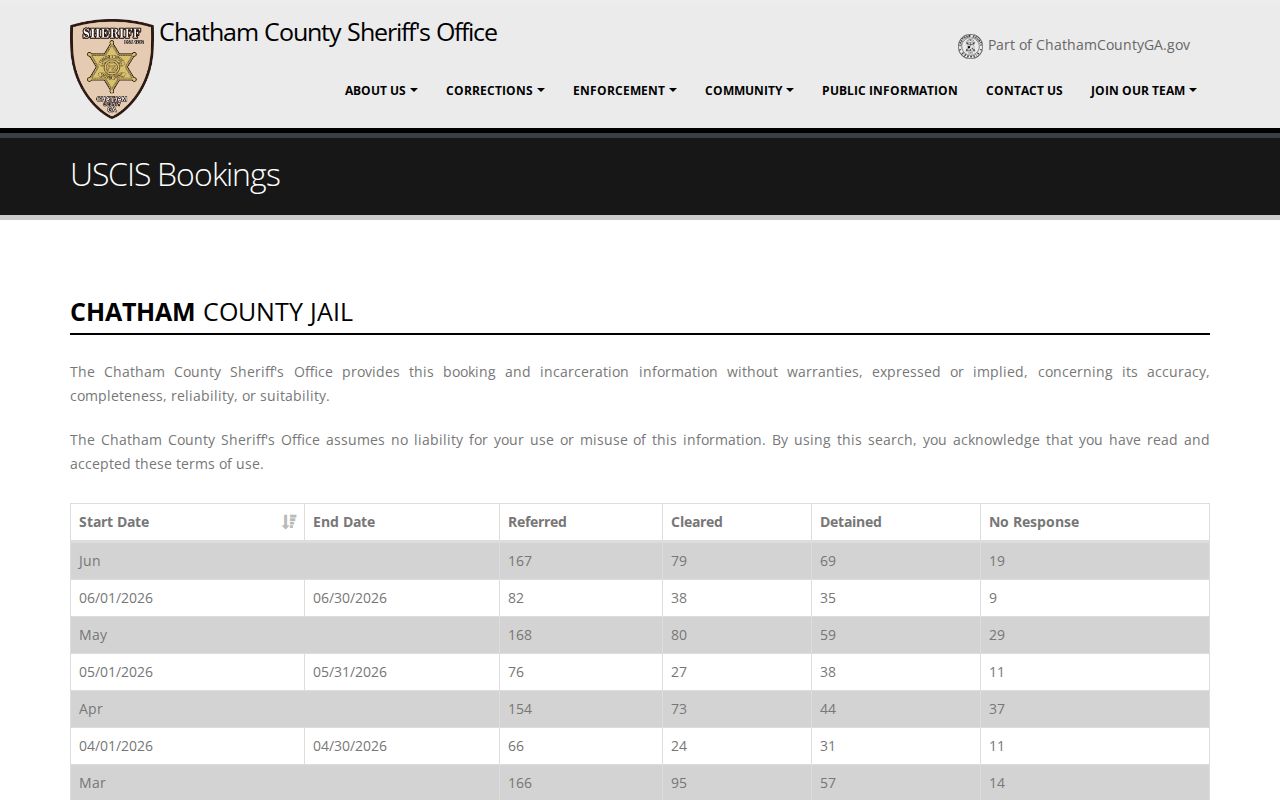
The captured Sheriff page shows totals and categories. It is not a detainee roster, release list, or individual immigration record.
Do not use a month, count, or category to infer what happened to a named person. “Cleared” in the aggregate table does not establish one person's release. “Detained” does not locate anyone. “No Response” is also a reporting category, not a person-level status. The page adds context only after the Sheriff and ICE tools have been used for the individual.
When Chatham Release Means Transfer
This is the facility-specific Section 19 detainer angle. A Chatham jail exit can mark a custody handoff instead of community release. The Sheriff's aggregate USCIS reporting supports that local distinction, while the person-level answer must come from the jail discharge record and ICE or DHS sources. A detainer is a request or hold connected with another authority; it can affect what happens when the original jail basis ends.
Ask Jail Records for the release or discharge record tied to the booking. Include the full name, date of birth if known, DIN, arrest number, booking date, and arresting agency. Request the recorded destination or transfer basis if available and not exempt. If the record says release to another authority, use the exact wording rather than recasting it as a community release.
The receiving system owns the next fact. ICE custody calls for the detainee locator and case channels. A federal criminal transfer would instead call for USMS, the federal docket, or BOP. GDC handles state custody. The Chatham County release search maps those routes when the receiving agency is not yet clear.
DHS Immigration Release Alerts
DHS-VINELink is an online DHS-VINE portal for victims and witnesses to obtain information about changes in custody status of aliens. Its purpose and coverage differ from the Georgia VINE portal used for participating state and local sources. Choose the DHS system only when the event is immigration-related and the service applies.
The official DHS-VINELink page is the source for the current interface and registration path.
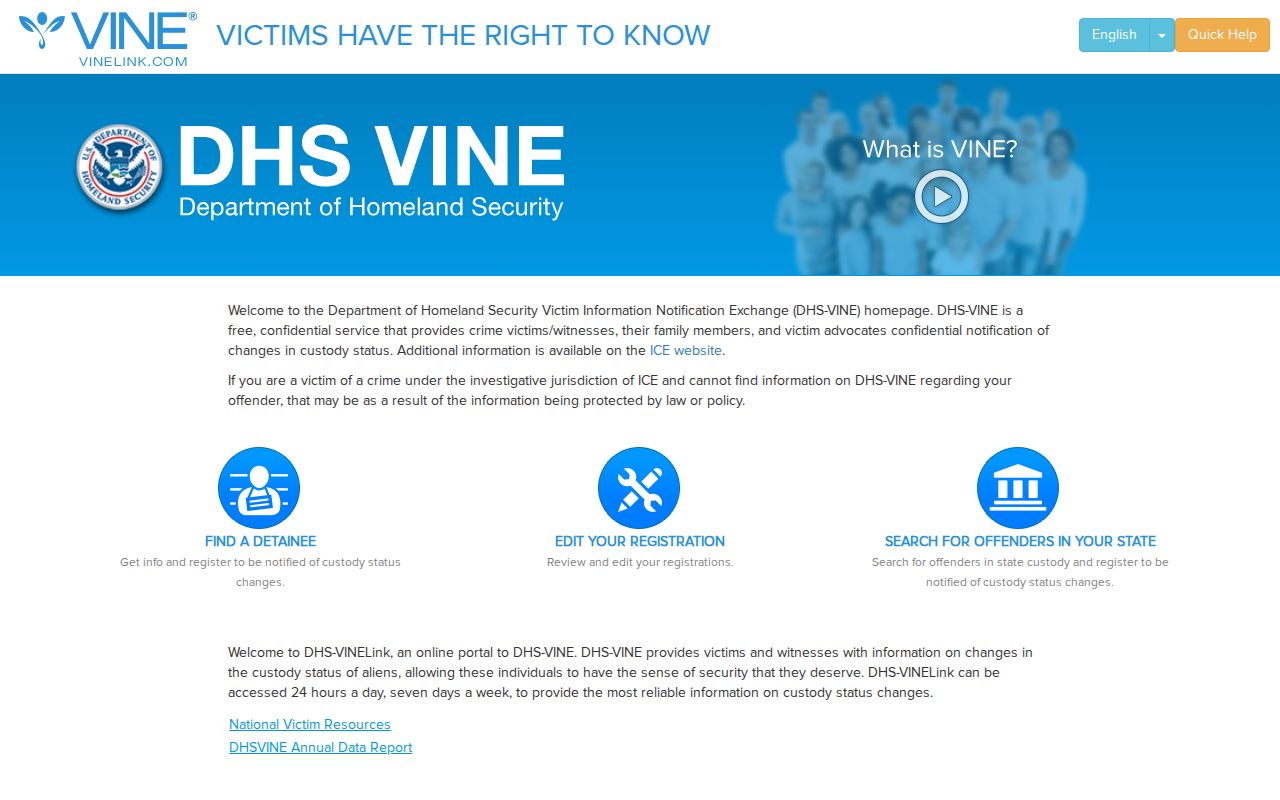
The screenshot shows the correct DHS service entry point. Interface labels can change, so follow the live portal and confirm alerts with the record-owning agency.
A notification may report a custody status change without providing the full release basis. Save the registration details securely, review the agency named in the alert, and verify the event through ICE or the proper case channel. Do not substitute a DHS alert for the Sheriff's county discharge record when both events matter.
Immigration Release Record Limits
Public locator coverage has limits. Spelling, aliases, an incorrect A-number, date of birth, country of birth, a recent transfer, or case stage can affect results. Some information may be protected. An absent result can call for better identifiers, a later check, or official case assistance. It does not prove that the person is free from custody.
The Sheriff aggregate page has a different limit: it cannot identify anyone at all. It should never be combined with a name from another source to guess an immigration outcome. Likewise, the 24-hour and 72-hour Sheriff pages are booking windows, not release or ICE rosters. Their agency and arrest fields help identify the county event only.
- A-number
- An immigration identifier used in person-level federal records.
- Detainer
- A request or hold that can affect release from another agency.
- Community release
- An end of custody that does not involve transfer to a receiving jail or detention system.
- Custody alert
- A notice of a status change that should be verified with the agency record.
Immigration Release Records Requests
For the Chatham portion, use Jail Records or submit a narrow request through the county's open-records process. Ask for the release or discharge record for one booking and any nonexempt record showing whether custody ended by community release or transfer. Do not ask the Sheriff to certify current ICE location, because that fact belongs to the receiving federal system.
For the immigration portion, use the federal record or case channel suited to the request. Provide the full legal name, A-number when known, date and country of birth, approximate custody dates, and the precise record sought. A narrow request can reduce confusion between the jail event, a referral, ICE detention, and later release.
Immigration proceedings can involve complex legal rights and deadlines. The record-navigation facts here are not legal advice. When the issue is a hearing, bond in immigration proceedings, removal, or eligibility for relief, use an authorized legal or official case channel. For release verification alone, preserve the source chain: Chatham discharge record, ICE person-level result, DHS alert if applicable, and the official case record.